Last Saturday, South Carolina was up 61-46 on Ole Miss with a little less than eleven minutes in the game. The Rebels would go on a 29-10 run the rest of the way to again barely beat the Gamecocks 75-71. Two weeks earlier, Ole Miss had rallied from a double digit halftime deficit to edge South Carolina 75-74. After so painfully losing a close game for a second time to the team that won the SEC Tournament last season, Frank Martin's team looked to rebound against Auburn Wednesday night.
As Martin would say in his post game interview with Gamecocks Radio play by play announcer Andy Demetra, the game plan was simple; help out on defense against the Tigers one-two guard punch of Chris Denson and KT Harrell. Denson and Harrell each score about twenty points a game and are Auburn's only two double digit scorers.
Duane Notice got the night started off right for the Gamecocks with a three pointer but Auburn would score the next five points. Demetrius Henry would tie the game at five, the first of three ties there would be over the first six plus minutes. Denson would break the last of the ties in that span with a three pointer to put Auburn up 18-15. The Tigers would keep the lead for the next twenty one minutes in the game.
Despite what Martin had said was the game, the Gamecocks could not contain Denson and Harrell. Though Auburn got help along the way from Tahj Shamsid-Deen and Allen Payne, it was the Tigers' two star guards who kept South Carolina at bay. Denson had eight points in the first nine and a half minutes in the game and scored twelve in the first half. Meanwhile, Harrell had ten first half points.
The only thing that kept the Gamecocks in the game in the first half was the continued torrid scoring of Brenton Williams. Williams, who had thirty two points in the loss last Saturday to the Rebels, would score eleven first half points to keep South Carolina close, 38-35 at the half. He has become the Gamecocks' main scoring threat this season.
Williams struggled to start the season. In the span of six non conference games starting with Clemson and ending with St Mary's, Williams failed to score in double figures in five of those six games. Even worse, Williams had zero points in three games; Clemson, Oklahoma State and Manhattan. Williams barely played against the Cowboys and the Jaspers, playing two minutes and six minutes respectively in those games.
Since the Diamond Head Classic game against St Mary's, Williams has scored in double figures in every game since, except the one point loss at home to Ole Miss, where he scored nine points all on free throws (he was 0-10 from the field). Including the game against the Tigers, Williams has averaged eighteen points per game over his last fourteen games. Over his last five games, he is averaging twenty two points per game, shooting a terrific forty three percent from beyond the arc and an awesome ninety six percent from the free throw line, which leads the nation among those that qualify.
Early in the second half, Williams would get the Gamecocks within two, 42-40 with another three pointer. A little later, Notice would again keep South Carolina within two with a layup, 44-42. But from there, things got out of hand defensively for the Gamecocks.
Over the span of four minutes, Auburn went on a 16-2 run. Again it was the duo of Denson and Harrell doing most of the damage. Denson and Harrell would combine for eleven of the sixteen points. Payne would cap the run nailing a three pointer to put the Tigers up 60-44 with 13:20 left in the game.
Auburn was scoring at will on South Carolina, as the Tigers made nine of their first eleven shots in the second half. Try as they might, Notice and Sindarius Thornwell could not handle guarding Denson and Harrell one on one. But that's OK if you are getting help on defense.
The problem was that the Gamecocks' front court was not helping out on defense. South Carolina also does not have a shot blocking presence in the middle. The Gamecocks would only have three blocks on the night, which is line with their average per game, 3.9 blocks, which puts them eleventh in the SEC in that category.
Despite their defensive struggles in the halfcourt, the Gamecocks would mount a furious rally, started by, who else, Williams. He would hit two free throws, then bury a three pointer to cut the lead to eleven, 60-49. Meanwhile the Gamecocks switched to a press, which completely throw off Auburn. The Tigers would commit six turnovers in a span of three and a half minutes.
This would result in an 18-2 run by the Gamecocks. Williams would score twelve of those points and a Mindaugas Kacinas layup would tie the game at sixty two with a little under eight minutes left, much to the delight of a now raucous Colonial Life Arena. When the Tigers went up sixteen, one of the season ticket holders in front of me was so frustrated by the Gamecocks play, he left. His friend of forty years sitting next to him stayed and credited the guy leaving with starting the rally, noting "Maybe he shouldn't come back here the rest of the season".
But a Shamsid-Deen dunk would put Auburn back up 64-62. Notice had a chance to tie the game, but missed one of two free throws to make the score 64-63. From there it was the Denson and Harrell show. Denson made a three point play and then later hit two free throws to put Auburn up 69-63. Then Harrell scored the Tigers' next eight points to keep the Auburn lead at six, 77-71. The Gamecocks would get within three, 77-74 with twenty three seconds left on what else, a Williams three pointer. But that was the last points on the game for South Carolina as Auburn won 79-74.
Williams had another terrific offensive night with twenty nine points on ten of fourteen shooting from the field, including six of ten from beyond the arc. Kacinas came off the bench to score fourteen points and Notice added twelve points. Thornwell struggled from the field shooting three of sixteen, but he did have nine assists and four steals to go with his eight points.
Williams, however, could not match the Auburn duo of Denson and Harrell. They each had twenty five points, combining to shoot seventeen of thirty from the field and twelve of fifteen from the line. The Tigers got help from Shamsid-Deen, who had twelve points and Payne added nine of his own. Auburn shot fifty two percent from the field, including a blistering sixty seven percent in the second half (14 of 21).
During his post game talk with Demetra, Martin called his team defense "selfish" as in there was no help defense for Thornwell and Notice on Denson and Harrell. As I noted at the beginning of the article, Martin noted that Auburn's game plan was simple, to get the ball to Denson and Harrell. But he also noted his team didn't do what was necessary to follow the game plan.
Staring at a 1-8 record in conference with a road game upcoming at Tennessee, South Carolina needs to right the ship soon. They are solidly in last place in the SEC, two games behind Auburn and Alabama. There needs to be more help on D if they want to get a W.
Saturday, February 8, 2014
Saturday, February 1, 2014
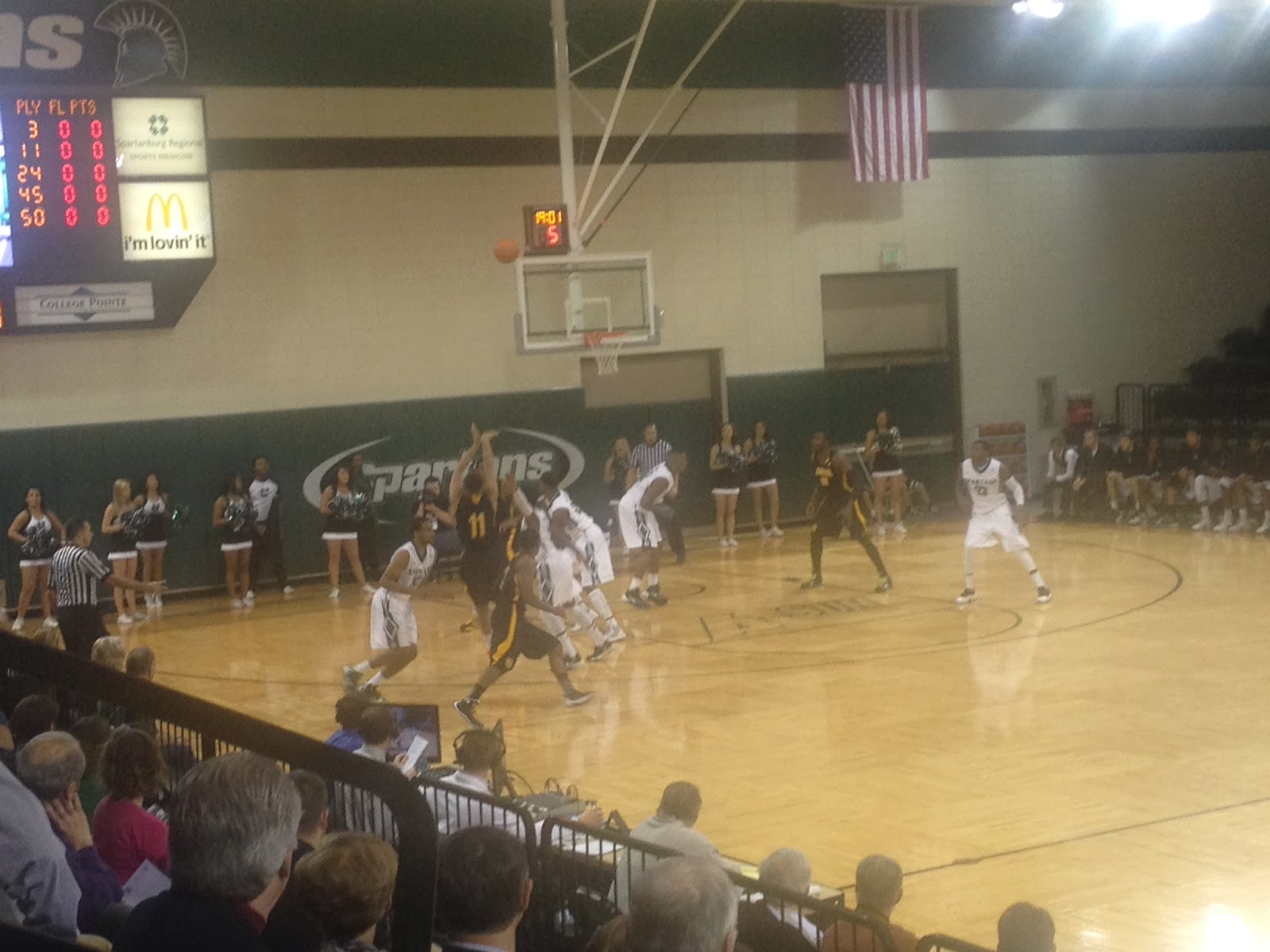
A Night of Cold Shots in Spartanburg (Recap of Kennesaw State v. USC Upstate)
And that's a cold shot, babyEarlier this week, it was cold enough in South Carolina that the entire state either saw sleet, freezing rain or snow on Tuesday night into Wednesday morning, causing schools to close and delay openings for several days and a good number of accidents on state highways. Columbia picked up three inches of snow.
Yeah that's a drag
That's a cold shot, baby
We've let our love go bad
"Cold Shot" by Stevie Ray Vaughan
The snowstorm didn't do as much damage to South Carolina as it did in Georgia. It was so icy that roads became impassable. Cars barely moved on roads for hours. All of the major highways in Atlanta became scenes from the Walking Dead as cars were abandoned by people who walked to nearby hotels and even strangers' houses who offered to put up people for the night thanks to a Facebook page.
It also resulted in the postponement of several games including the Kennesaw State - USC Upstate game Thursday night because the Owls couldn't get out of Georgia due to the condition of the roads. Thus the game was rescheduled for Friday night at the Hodge Center, which allowed me to attend the game.
Earlier in the season, Kennesaw State knocked off USC Upstate at home 68-58. In that game, the Owls had four players in double figures scoring, shot forty three percent from beyond the arc and hit on twenty one of their twenty five free throws. Kennesaw State led by as much as eighteen points as they won their first and only game so far this season in Atlantic Sun conference play. Friday night would turn out to be a much different matter.
I left work at 5:00 PM and made the ninety plus minute trip from Columbia to Spartanburg. One of the interesting things about the Hodge Center is that they offer general admission as well as reserved seating, which is kind of unusual since the gym only holds 818. But if general admission is available, you can sit in the A section mid level for eight dollars. The only difference is that you are not sitting center court but on one of end of the court, which is no big deal. Throw in a over-buttery pretzel for two dollars and you have yourself a relatively inexpensive evening.
Despite missing second leading scorer Ty Greene to an injury, the Spartans jumped out early thanks to Ricardo Glenn's aggressive post play. Glenn scored six of the first ten USC Upstate points. A pretty feed by Fred Miller resulted in a "Big Mike" Buchanan layup as the Spartans led 10-6. Meanwhile, Kennesaw State's three point shooting was as icy as the Atlanta roads on Tuesday. In the first three and a half minutes, they missed all four of their three point attempts.
But the Owls responded with a 7-0 spurt. After a three point play by Nate Rucker, Yonel Brown assisted on an Orlando Coleman layup to give Kennesaw State a 13-10 lead with a little over twelve minutes left in the half. Brown, very generously listed at five foot nine, was serenaded by the Spartans' student section with a chant of "Little Boy" every time he touched the ball.
The teams would trade the lead and cold spells several times over the next several minutes. The Owls would go four plus minutes without hitting a basket as Glenn would give the Spartans a 14-13 lead. It would be a reserve forward that would break the scoring drought for Kennesaw State.
Willy Kouassi, a six foot ten sophomore forward who went scoreless in fourteen minutes of action in the first game between the teams, gave the Owls a much needed inside scoring presence. Over the span of about three and a half minutes, Kouassi would score eight points and assist on another basket. His jumper gave Kennesaw State a 24-22 lead at the under four minute media timeout.
For some reason, the Spartans had moved away from getting the ball inside to Glenn and settled instead for three point shots that equally matched the Owls' frigid shooting beyond the arc. USC Upstate missed on all ten of their three point attempts in the first half. The Owls had six of the last eight points that were scored in the last three minutes and forty two seconds of the half. Kennesaw State limped into the half with a 28-26 lead.
The two teams combined to miss on all seventeen of their three point attempts in the first half. Thanks to Kouassi hitting on five of his first six field goal attempts, Kennesaw State shot thirty eight percent despite missing all seven of their shots beyond the arc. USC Upstate only shot thirty four percent and also missed on three of their seven free throws. Both teams had eleven field goals in the first half and the difference was two more free throws by the Owls.
In the second half, after Kouassi made one of two free throws, Spartans' forward Torrey Craig FINALLY hit the first three pointer of the game by both teams, which tied the game at twenty nine. But once again, both teams would hit a cold spell as there was no scoring whatsoever over the next two and half plus minutes. Delbert Love would eventually hit a layup to give Kennesaw State a 31-29 lead with sixteen minutes left.
But it would be the last field goal the Owls would make for the next five minutes as Myles Hamilton would do all their scoring with four free throws. Despite that, the Spartans couldn't take advantage. After a Jodd Maxey layup for USC Upstate, the game was tied at thirty five. Hamilton would finally end Kennesaw State's field goal drought with a layup to put the Owls back up 37-35. After Fred Miller gave the Spartans the lead back with a three pointer, Bernard Morena would respond with a basket and Kennesaw State had a 39-38 lead with ten minutes left.
It would be the last lead of the game for the Owls.
USC Upstate got the ball back inside to Glenn, who was fouled and made two free throws. Then Craig got the crowd of six hundred plus into the game by burying another three pointer. Maxey followed with a jumper to put the Spartans up 45-39 and Kennesaw State called a thirty second timeout. Two Hamilton free throws stemmed the tide for a little bit as the Owls were only down four, 45-41.
But Glenn again was big, hitting a layup and one. His three point play extended the lead to seven 48-41. Four USC Upstate free throws later made the score 52-41. The Spartans had outscored the Owls 14-2 over the span of four and half minutes.
A Karim Mawuenyega three pointer extended the USC Upstate lead to fourteen, 57-43. Mawuenyega was fouled on his next three point shot attempt, which went in and out, much to the dismay of the Spartans' fans. Instead of a potential four point play, Mawuenyega had to settle for three free throw attempts. Unfortunately, he missed on all three attempts.
All that was left was whether Kennesaw State would actually hit a three pointer. Taylor Wozniak finally made one to make the score 57-46. But it was the only one the Owls hit on the day as they were an Antarctic one of fourteen from beyond the arc. USC Upstate would go onto win 65-48.
In the three games I have now seen USC Upstate play in person, Glenn has had a double double in each of them. He led all scorers with nineteen points and added twelve rebounds. Craig also had a double double with sixteen points and eleven rebounds. Maxey added twelve points for the Spartans who shot thirty eight percent from the field, including a frosty four of twenty one from beyond the arc.
Kouassi, who hails from the Ivory Coast, also had a double double, leading the Owls with fifteen points and eleven rebounds. The career high fifteen points matched his output from his previous game, a loss to Florida Gulf Coast. Hamilton was the only other Owl in double figures with ten points. The Owls only shot thirty one percent from the field and were not exactly on fire from the line as they only made thirteen of their twenty one free throws.
USC Upstate now finds itself in fourth place in the Atlantic Sun with a 5-4 conference record. They have a chance to improve their standing in the A-Sun when they host first place Mercer on Sunday. The temperature on Sunday in South Carolina should be close to seventy degrees.
Hopefully the warm front will mean warmer shooting at the Hodge Center.
Thursday, January 30, 2014
A Day of Firsts for South Carolina (Recap of Texas A&M v. South Carolina)
At around 3:00 AM or so Wednesday morning, Winter Storm Leon wound down around Columbia, South Carolina. It left about two to three inches of snow in the Columbia area, certainly around where I live in Forest Acres, which is fifteen minutes from the Colonial Life Arena, where the Gamecocks were hosting the Aggies of Texas A&M on Wednesday evening. It was the first and likely only snowstorm of the season in South Carolina.
Having lived in Long Island, New York for forty six plus years, two to three inches of snow/mixed with ice is nowhere near what I consider a snowstorm. But it can cause havoc in Southeast cities not used to having snow/ice or not prepared in stopping it. Such was the case in Atlanta and Alabama on Tuesday, where despite a winter storm warning, schools were in session and most people were at work. It resulted in a complete mess, with ice covered roads causing more than 1,000 accidents in Georgia and highways were complete logjams. Kids were stuck overnight in schools in Georgia and Alabama. Hundreds of people abandoned their cars as they could not get around due to the ice and traffic jams.
Here in South Carolina, we were better prepared. Knowing that the National Weather Service had an issued a Winter Storm Warning starting at 11:00 AM on Tuesday, schools chose to close on Tuesday as did state and county offices. Most universities, including the University of South Carolina, where I work, were closed. Nikki Haley, the Governor, declared a state of emergency before any snow had started in Columbia. Most people heeded the warnings and stayed off the roads.
Again on Wednesday, schools were closed, along with the University of South Carolina, as well as state and county offices. So just like most other kids, my two sons had the day off and enjoyed the snow, which is very much a rarity in the South. Yes, I indulged in a few snowballs with my two children. But come the afternoon, I had serious cabin fever. Thankfully, the game was still on for Wednesday evening and I needed the two hour college basketball fix.
It turns out Wednesday night that the roads were quite fine and really no issues of ice. And as a result, what I thought might have been a low turnout turned out to be a crowd of nearly 10,000. The students, knowing they had a two hour delay on Thursday, came out in droves hoping for a win that evening.
Entering the game, the Gamecocks had not won a game in conference. The 0-6 record was a little misleading in that South Carolina had been in most of their games, losing four games by eight points or less. This included an 75-67 loss at Texas A&M earlier in the season. The Aggies came into the game at 3-3 in conference.
After a very pretty rendition of the national anthem by the vocal group "The Gamechords", the Gamecocks jumped out quickly on the Aggies. Duane Notice, who has been very solid since he joined the starting lineup, buried a three pointer and Michael Carrera, also back in the starting lineup, hit an old fashioned three point play. A short time later, Brenton Williams nailed a three pointer of his own and South Carolina was up 15-5.
Texas A&M would cut the lead to six, 17-11 on a couple of three pointers by Antwan Space and Jordan Green. And for nearly the next three and a half minutes, the Aggies would stay in range, only trailing by six, 21-15. After Carrera dribbled into traffic, which resulted in a steal by Texas A&M, Martin replaced him. As Carrera walked by, Martin yelled loudly at him "PASS THE BALL!"
But South Carolina would make sure that Texas A&M would not hang around much longer as they on a 17-2 run over the span of five plus minutes. With two plus minutes left in the half, the Gamecocks were up 38-17. What was impressive about the run was that it was balanced. Laimonas Chatkevicius came off the bench and scored eight points during the run. Thornwell had four points in the span and Williams had a three pointer. When you looked up at the scoreboard and saw players with eight, seven and six points, it was impressive. Brenton Williams capped the half with a three pointer and the Gamecocks led 41-21 at halftime.
But it was not only the offense that was impressive for South Carolina in the first half. The defense came to play. They were aggressive, forcing ten Texas A&M turnovers in the first twenty minutes. They also held the Aggies, who shot fifty five percent in their home win over the Gamecocks, to thirty three percent from the field in the first half. It was the best all around twenty minutes that I had seen South Carolina play all season in person.
And the fans got involved, especially the student section. Whether it was their own cabin fever after not having school for two days or starved for a conference win, the students were the loudest I had heard for a men's game all season.
The problem with a young team like the Gamecocks is sustaining a high level of play for forty minutes. Sure enough at the start of the second half, South Carolina committed four turnovers in the first two and a half minutes. Texas A&M cut the deficit down to thirteen, 43-30 on a Kourtney Robertson layup.
But Notice made sure that was as close as the Aggies would get the rest of the way. He would score ten of the Gamecocks' first twelve points in the second half. His three point play would put South Carolina up 53-37 with fourteen plus minutes left in the game.
From there, the Gamecocks went on a 19-4 run over about seven minutes. Sindarius Thornwell would hit six free throws in a row. His last free throw would give South Carolina a 69-41 lead with seven and a half minutes left in the game.
All that was left was for both teams to clear the benches and play seldom used reserves. The Gamecocks would actually extend the lead to thirty two points before winning by twenty eight, 80-52 to get their first SEC win.
The Gamecocks had four scorers in double figures led by Notice and Thornwell, each with nineteen points. Williams, despite missing two free throws, which gave him now three misses on the season, added eighteen points. Chatkevicius had a career high twelve points. The Gamecocks shot fifty two percent from the field and eighty one percent from the line (26 of 32).
The Aggies had no players in double figures in scoring. Space and Jamal Jones each had nine points for Texas A&M. The Aggies shot thirty five percent from the field and were just four of sixteen from beyond the arc.
As I left Colonial Life Arena, I heard several fans talk about maybe there should be a snowstorm more often in Columbia since the first snow of the season brought the team its first SEC win of the season. As much as that might have been a good luck charm for the Gamecocks and as much as I loved seeing my boys make a robot snowman, I gladly hope there are no more snowstorms this year. I had enough cabin fever for the rest of the season. If snow is a good luck charm, perhaps the Riverbanks Zoo can lend their snow machine from their Christmas Light show to the basketball team.
But hopefully, it's not the snow, but the start of something for the Gamecocks' basketball team. What I saw Wednesday night was the equivalent of this weekend's upcoming warm front.
Something hopeful.
Monday, January 27, 2014
Careful For What You Wish For
I have been writing this blog, The College Hardwood, since December 2005. I can't remember writing a post based specifically on watching one game. But here I was on an early Sunday afternoon in Columbia, South Carolina watching the entire Fordham vs. UMass game on the NBC Sports Network. The Minutemen absolutely pasted the Rams 90-52. It was how the Rams played or didn't play that inspired me to write this post.
So many things I saw Fordham do on the court, or actually not do, I had seen before. Players not moving without the ball on offense while waiting for their best player, who is dribbling at the top of the key, to "create" as he finally makes his one on one move to the basket. Too much dribbling, too many bad shots, too many three pointers instead of working the ball inside. Hell, no inside game whatsoever.
That's because I had seen it all before. Fordham's coach is Tom Pecora, who previously coached at Hofstra for nine seasons. For nine seasons, I had a prime seat to all of Pecora's teams' style of play.
Pecora left Hofstra for Fordham after nine seasons, mainly for two reasons. One reason was that he was tired of the southern tilt of the CAA. He felt the Pride never had a fair shot to win in the Colonial and my guess is that he especially felt jaded after the 2005-06 season which ended in a NCAA snub.
Second, Pecora, even the Hofstra administration at the time, wanted to be in the A-10, but there was little hope of Hofstra ever being able to join the A-10. Fordham gave him an opportunity to be in the A-10 and with his ability to recruit, Pecora felt he could succeed in the A-10. Fordham saw a coach who, in his last five seasons, had four twenty plus win campaigns and three trips to the postseason. An amount of success Fordham hadn't seen in ages. It seemed like a perfect match.
Recruiting has never been a question with Pecora and I certainly believe he has a knack for talent. Over the years, Pecora has recruited Speedy Claxton, Norman Richardson, Rick Apodaca, Kenny Adeleke, Loren Stokes, Antoine Agudio, Carlos Rivera, Adrian Uter, Aurimas Kieza, Charles Jenkins, Chaz Williams, Halil Kanacevic, Brenden Frazier and Jon Severe.
Three of those players; Claxton, Richardson and Jenkins have played in the NBA. There's a good chance that Chaz Williams will make it four. It's an impressive list of talent. If I had to say who was the top three of Pecora's all time recruits I would say right now Claxton, Jenkins and Agudio. Chaz is catching up fast though.
And Pecora was successful with Hofstra. He did have four twenty plus win seasons, three NIT appearances and a .552 won lost percentage with the Pride. And it did take time for Hofstra to succeed, as Hofstra had losing records in each of Pecora's first three seasons before breaking through with a 21-9 record and a NIT appearance in the 2004-05 season. So it stands to reason that Fordham fans should be patient with Pecora and let him build a winning program.
Based on the previous paragraph, you would think Pecora would be somewhat successful or his team would show improvement going into his fourth year at Fordham, correct? Well, halfway through Pecora's fourth season at Fordham, his overall record is 32-75. The Rams have currently only eight conference wins in those three and half seasons. His current team is 8-11 and has only one win in conference.
Compare that to his Hofstra teams. In Pecora's second season, his team went 8-21 and 6-12 in conference. In Pecora's third season at Hofstra, the team improved to 14-16 and 10-8 in conference. In Pecora's second season with Fordham, the Rams went 10-19 and 3-13 in conference. Last season, they actually were worse, 7-24 and again 3-13 in conference. In Fordham's non conference losses last season, the average margin of loss was sixteen points . In their conference losses, the average margin was thirteen points. Sixteen of their twenty four losses were by double digit margins.
This season, they are 7-6 in non conference, which is certainly better than last season, but again the Rams are on pace for only three wins in conference after their 1-5 A-10 start. In their twelve losses this season, their average margin of loss is sixteen points and they have seven double digit losses. Three of their five conference losses are by twelve points (home loss to Dayton), twenty four points (road loss to St Louis) and after yesterday's drubbing by UMass, thirty eight points respectively. Their only win in conference is over winless George Mason. At this point, there seems to be little or no improvement.
So what are the reasons for Pecora's struggles with Fordham? I have certainly noted that Pecora can recruit and anyone with a basketball sense can tell you that Frazier and Severe are good ball players. Well there are a couple of reasons.
The first obvious reason is that the A-10 is stronger than the CAA. Much stronger. The only exception might have been the 2010-11 season where the CAA had three teams make the NCAA Tournament. And two of those teams, VCU and George Mason are now in the Atlantic Ten. There are no days off in the A-10 and there are no Towsons (well the Towson we used to know, not the good Pat Skerry teams of now) or Benny Moss' UNCW teams to feast on during the season. Every team in the A-10 has a lot of talent.
But there's another point to be made. One, if you look a little closer under the hood and if you watched the Hofstra games in person, you would know why Fordham can't compete with the UMass', VCU's, St Louis' or even Rhode Island.
I'll be blunt. It's the Xs and Os on offense. It's the coaching.
I want to take the time to note that what is about to be written here is not personal. I have heard a lot of good things about Pecora over the years, that he is a nice guy. I have that based on several people I hold in high regard. What I am writing about is strictly from a coaching standpoint.
Defensively, I have never had a problem with Pecora. Pecora's teams could always rebound. The Rams are currently 58th in the country in rebounds.
His Hofstra teams were also pretty decent defensively, as they played just about always man to man. My favorite game of Pecora's tenure was the CAA Tournament Semifinal vs. George Mason. In the final twenty minutes, the Pride held the Patriots to just sixteen second half points, Tony Skinn nut punch and all, as Hofstra beat Mason convincingly 58-49. Mason shot four of twenty three in the second half. Every Pride fan in attendance thought Hofstra was going to get an at large based on that dominant second half performance.
After the 2006 NCAA snubbing, the Pride were favored to win the CAA in the 2006-07 season. In the 2006-07 season, they led the CAA shooting 41.2 percent from beyond the arc. But the Pride only finished third in the CAA that season and got upset in the CAA Quarterfinals by George Mason, a team they had dominated earlier in the regular season.
So what happened?
Well that 2005-06 team that went 26-7 was truly special. Not only did you have Stokes, Agudio and Carlos Rivera, easily the best three guard group in the history of Hofstra, but you also had a very good frontcourt of Uter and Kieza. Uter just missed averaging ten points per game, otherwise you would have had a starting lineup that all averaged in double figures in scoring. Uter and Kieza could also rebound (both were in the top ten in rebounding in the CAA that season) and Uter perfectly played the part of the dominant shot blocker as he was fourth in the CAA in blocks per game. It was a balanced offensive team, where all five players could score, as well as a very solid defensive team.
Uter and Kieza graduated after the 2005-06 season. Pecora didn't have any suitable replacements as Chris Gadley, Arminas Urbutis, Mike Davis Sabb and Ziggy Sestokas literally combined couldn't match the totals of Uter and Kieza from an offensive or rebounding standpoint. It was basically Stokes, Agudio and Rivera carrying that team in 2006-07.
In that quarterfinal game against George Mason, Pecora inexplicably started Sestokas at the four, along with Davis Sabb, despite Mason's tall, talented beefy front line of Darryl Monroe and Will Thomas, who outrebounded Hofstra 36-27. Urbutis would have been a better choice at the four (and I was saying that before the game started).
As a result, the Patriots jumped out to a fifteen point halftime lead. The Pride rallied and had a chance to tie late in regulation, but Greg Johnson inexplicably drove the lane down three points, along with two Mason players who inexplicably followed him and put up a wild floater instead of kicking out to an open shooter beyond the arc. I know. I was there at Richmond Coliseum that day. The Pride lost 64-61.
In those three seasons with Stokes, Agudio and Rivera, Hofstra was 40-14 in conference but only made the CAA championship game once, in 2006. In fact, in Pecora's nine seasons, Hofstra only made the CAA championship game once and the semifinals three times.
After Stokes and Rivera left, the Pride struggled the next season, the 2007-08 season, despite the amazing Agudio and the CAA Rookie of the Year, Jenkins. Agudio would often win games by himself at the end of a game. Despite Agudio and Jenkins, the Pride finished 12-18, including 8-10 in conference in Agudio's senior season.
The season after, the 2008-09 season,the Pride won twenty one games, including an 11-7 record in conference. But upon closer look, the record is not truly indicative of how Hofstra did that season.
The Pride started off the season 8-1 (including an early conference win over Towson) and were 8-3 in non-conference games. One of their wins was over a Division III opponent, SUNY Old Westbury. Only three of their seven Division I non conference wins came against teams over .500, and two of them, Stony Brook and Manhattan were each 16-14 on the season. Only a Charleston Classic win over East Tennessee State, an eventual NCAA Tournament team that won twenty three games that season stands out in the non conference schedule.
In conference, Hofstra was 2-7 against teams that finished over .500 in conference; home wins vs. Northeastern and Old Dominion, home and road losses to Drexel, home and road losses to VCU, a road loss to Northeastern, a twenty four point loss at George Mason and a one point loss in the CAA Tournament to Old Dominion. If you include their two wins over James Madison, who finished 9-9 in conference and 21-15 overall, then the Pride were 4-7 against above .500 teams overall in the CAA.
Then came the 2009-10 season, the freshman seasons for Chaz Williams and Halil Kanacevic and Jenkins was the CAA Player of the Year that season. Williams and Kanacevic each made the All CAA Rookie Team. Yet, Hofstra went 19-15 and 10-8 in conference.
Hofstra won only two games ALL SEASON against Division I teams that finished over .500 overall; Fairfield and Northeastern. All nine of their conference losses, eight in regular season and one in CAA Tournament came against teams above .500 in conference. Their only wins against teams above .500 in conference were again Northeastern and Drexel.
By the way, all the pictures you see in this article are from the 2009-10 season.
Over Pecora's last two seasons with the Pride, Hofstra's record against teams above .500 in the CAA was 4-16 (including the two CAA Tournament losses). Four and Sixteen. This is not the first time I noted this. I noted this when I was pushing Tim Cluess for head coach of Hofstra. (see how Cluess has worked out for Iona?)
Now think about that record in regards to now playing quality teams in the A-10 every night. Enough said.
Now we all know what happened after Pecora left. Chaz and Halil left to go to UMass and St Joe's in the A-10 respectively. Tim Welsh was hired and basically fired after 30 days on the job due to a DUI arrest. Mo Cassara came in, did a heck of a job in his first season with basically just Charles Jenkins and Mike Moore in an incredibly tough CAA. Then after a tough second season and the four idiots arrests in his third season after the Pride started 3-2, Cassara was unfortunately fired and Joe Mihalich was hired to replace Cassara.
So what I often hear from friends and college basketball bloggers I follow on Twitter (many of whom follow me as well) is "Imagine if Pecora stayed. Imagine what could have been with Jenkins, Chaz and Halil". It's something I have thought of many times myself.
Well after yesterday's game and all the evidence I have shown above, I am here to tell you something. It probably would have been more of the same of the 2009-10 season.
Heck, they went 10-8 together that 2009-10 season in a CAA that was nowhere near as tough as the 2010-11 season where three CAA teams made the NCAA Tournament, two teams won a NCAA game; VCU and George Mason, one team lost to the eventual National Runner up Butler on a buzzer beater; Old Dominon and one, VCU, went to the Final Four. Perhaps with the addition of Mike Moore and Frazier, who Pecora first recruited to Hofstra, things would have been different. But what makes you think Pecora would have got more out of them?
Think about what Mo Cassara did without Kanacevic and Chaz in his first year as a head coach on the Division I level. He took a team, that on paper was not as good as the season before, and he got them to finish four games better in a tougher conference than the season before, and they made it to the CAA Semifinals for the first time since 2006.
And despite what has happened since Cassara's magical first season, I would rather have Hofstra now under Mihalich than with Pecora, considering Mihalich's long, successful tenure at Niagara. Having watched several of Hofstra's games this season online and one in person, Mihalich's offense is fun to watch. They actually move without the ball. And he has the Pride already with three wins in conference, a team that was picked to finish last in the CAA and is basically a placeholder until four of Mihalich's players (three transfers) are eligible next season.
I thought that maybe with better talent to recruit since Fordham was in the A-10, you might see Pecora developing a more rounded team. A team that had inside post play as well as good guards. A team that would be competitive night in and night out. I wasn't expecting the Rams to be in the top third of the A-10, but at least respectable, given Pecora's ability to recruit.
And yet, four years later, I see the same things in Fordham games that I did in Hofstra games. No ball movement, a guard oriented dribble drive offense where the guard stands at the top of the key and tries to "create", while four other players stand around and no post play on offense whatsoever. Pecora only recruited and developed four good post players at Hofstra; Adeleke, Uter, Kieza and Kanacevic. He inherited Chris Gaston when he took over Fordham, so he doesn't count.
One frontcourt player he recruited to both Hofstra and then Fordham, Marvin Dominique, barely touched the ball in his two years with the Rams. Dominique transferred to St Peter's, where he has flourished. The junior forward averages nearly eighteen points and nine rebounds per game for the Peacocks.
Pecora's teams have basically become guard oriented and have been since the 2006-07 season. You could get away with it for the most part in the CAA against teams with less talent or with three outstanding guards like Stokes, Agudio and Rivera. However, the last two seasons at Hofstra showed he couldn't beat good teams when necessary. The problem is you need good inside post play to balance your offense. Talented A-10 teams have exploited and exacerbated that with Fordham, especially this season.
Pecora got what he wanted in 2010 when he took the Fordham job, a chance to coach in the A-10. The problem is that the evidence seems to indicate he bit off more than he could chew from a coaching standpoint. Being able to recruit talent is one thing. Frazier and Severe are very talented. However, being able to coach talent in an elite league like the Atlantic Ten is another matter.
What's ironic is that the teams Pecora was trying to get away from in the Colonial; southern based teams like VCU and Mason are now in the A-10. Meanwhile, the CAA is basically now the old America East with a couple of Southern teams sprinkled in.
I had considered writing this for a while, but I held off. One play on Sunday put me over the edge. In Fordham's last possession before the half, Pecora had Frazier dribble at the top of the key, while the four other Ram players just stood around. Finally, one of the Ram bigs came out for a ball screen. Frazier drove, then tried to pass the ball back. He threw it away for a back court violation.
It was similar to that 2007-08 season, where time after time Pecora had Agudio run that same play at the end of games. Though my friends Mal, Tieff and I hated that play, Agudio would often succeed (and also would take the shot and not pass back).
But Frazier is not Agudio. UMass is not the 2007-08 James Madison. And the A-10 is not the 2007-08 CAA, or the 2008-09 CAA or 2009-10 CAA for that matter.
My guess is that Fordham fans have finally figured this out. The question is, has the Fordham administration figured that out?
So many things I saw Fordham do on the court, or actually not do, I had seen before. Players not moving without the ball on offense while waiting for their best player, who is dribbling at the top of the key, to "create" as he finally makes his one on one move to the basket. Too much dribbling, too many bad shots, too many three pointers instead of working the ball inside. Hell, no inside game whatsoever.
That's because I had seen it all before. Fordham's coach is Tom Pecora, who previously coached at Hofstra for nine seasons. For nine seasons, I had a prime seat to all of Pecora's teams' style of play.
Pecora left Hofstra for Fordham after nine seasons, mainly for two reasons. One reason was that he was tired of the southern tilt of the CAA. He felt the Pride never had a fair shot to win in the Colonial and my guess is that he especially felt jaded after the 2005-06 season which ended in a NCAA snub.
Second, Pecora, even the Hofstra administration at the time, wanted to be in the A-10, but there was little hope of Hofstra ever being able to join the A-10. Fordham gave him an opportunity to be in the A-10 and with his ability to recruit, Pecora felt he could succeed in the A-10. Fordham saw a coach who, in his last five seasons, had four twenty plus win campaigns and three trips to the postseason. An amount of success Fordham hadn't seen in ages. It seemed like a perfect match.
Recruiting has never been a question with Pecora and I certainly believe he has a knack for talent. Over the years, Pecora has recruited Speedy Claxton, Norman Richardson, Rick Apodaca, Kenny Adeleke, Loren Stokes, Antoine Agudio, Carlos Rivera, Adrian Uter, Aurimas Kieza, Charles Jenkins, Chaz Williams, Halil Kanacevic, Brenden Frazier and Jon Severe.
Three of those players; Claxton, Richardson and Jenkins have played in the NBA. There's a good chance that Chaz Williams will make it four. It's an impressive list of talent. If I had to say who was the top three of Pecora's all time recruits I would say right now Claxton, Jenkins and Agudio. Chaz is catching up fast though.
And Pecora was successful with Hofstra. He did have four twenty plus win seasons, three NIT appearances and a .552 won lost percentage with the Pride. And it did take time for Hofstra to succeed, as Hofstra had losing records in each of Pecora's first three seasons before breaking through with a 21-9 record and a NIT appearance in the 2004-05 season. So it stands to reason that Fordham fans should be patient with Pecora and let him build a winning program.
Based on the previous paragraph, you would think Pecora would be somewhat successful or his team would show improvement going into his fourth year at Fordham, correct? Well, halfway through Pecora's fourth season at Fordham, his overall record is 32-75. The Rams have currently only eight conference wins in those three and half seasons. His current team is 8-11 and has only one win in conference.
Compare that to his Hofstra teams. In Pecora's second season, his team went 8-21 and 6-12 in conference. In Pecora's third season at Hofstra, the team improved to 14-16 and 10-8 in conference. In Pecora's second season with Fordham, the Rams went 10-19 and 3-13 in conference. Last season, they actually were worse, 7-24 and again 3-13 in conference. In Fordham's non conference losses last season, the average margin of loss was sixteen points . In their conference losses, the average margin was thirteen points. Sixteen of their twenty four losses were by double digit margins.
This season, they are 7-6 in non conference, which is certainly better than last season, but again the Rams are on pace for only three wins in conference after their 1-5 A-10 start. In their twelve losses this season, their average margin of loss is sixteen points and they have seven double digit losses. Three of their five conference losses are by twelve points (home loss to Dayton), twenty four points (road loss to St Louis) and after yesterday's drubbing by UMass, thirty eight points respectively. Their only win in conference is over winless George Mason. At this point, there seems to be little or no improvement.
So what are the reasons for Pecora's struggles with Fordham? I have certainly noted that Pecora can recruit and anyone with a basketball sense can tell you that Frazier and Severe are good ball players. Well there are a couple of reasons.
The first obvious reason is that the A-10 is stronger than the CAA. Much stronger. The only exception might have been the 2010-11 season where the CAA had three teams make the NCAA Tournament. And two of those teams, VCU and George Mason are now in the Atlantic Ten. There are no days off in the A-10 and there are no Towsons (well the Towson we used to know, not the good Pat Skerry teams of now) or Benny Moss' UNCW teams to feast on during the season. Every team in the A-10 has a lot of talent.
As for the facilities argument, I don't buy that. The Rose Hill Gym doesn't seat a lot of people, but it's a nice gym and if the Rams play well, it would sell out regularly (which it doesn't) and then you could have an argument for a larger arena.
But there's another point to be made. One, if you look a little closer under the hood and if you watched the Hofstra games in person, you would know why Fordham can't compete with the UMass', VCU's, St Louis' or even Rhode Island.
I'll be blunt. It's the Xs and Os on offense. It's the coaching.
I want to take the time to note that what is about to be written here is not personal. I have heard a lot of good things about Pecora over the years, that he is a nice guy. I have that based on several people I hold in high regard. What I am writing about is strictly from a coaching standpoint.
Defensively, I have never had a problem with Pecora. Pecora's teams could always rebound. The Rams are currently 58th in the country in rebounds.
His Hofstra teams were also pretty decent defensively, as they played just about always man to man. My favorite game of Pecora's tenure was the CAA Tournament Semifinal vs. George Mason. In the final twenty minutes, the Pride held the Patriots to just sixteen second half points, Tony Skinn nut punch and all, as Hofstra beat Mason convincingly 58-49. Mason shot four of twenty three in the second half. Every Pride fan in attendance thought Hofstra was going to get an at large based on that dominant second half performance.
After the 2006 NCAA snubbing, the Pride were favored to win the CAA in the 2006-07 season. In the 2006-07 season, they led the CAA shooting 41.2 percent from beyond the arc. But the Pride only finished third in the CAA that season and got upset in the CAA Quarterfinals by George Mason, a team they had dominated earlier in the regular season.
So what happened?
Well that 2005-06 team that went 26-7 was truly special. Not only did you have Stokes, Agudio and Carlos Rivera, easily the best three guard group in the history of Hofstra, but you also had a very good frontcourt of Uter and Kieza. Uter just missed averaging ten points per game, otherwise you would have had a starting lineup that all averaged in double figures in scoring. Uter and Kieza could also rebound (both were in the top ten in rebounding in the CAA that season) and Uter perfectly played the part of the dominant shot blocker as he was fourth in the CAA in blocks per game. It was a balanced offensive team, where all five players could score, as well as a very solid defensive team.
Uter and Kieza graduated after the 2005-06 season. Pecora didn't have any suitable replacements as Chris Gadley, Arminas Urbutis, Mike Davis Sabb and Ziggy Sestokas literally combined couldn't match the totals of Uter and Kieza from an offensive or rebounding standpoint. It was basically Stokes, Agudio and Rivera carrying that team in 2006-07.
In that quarterfinal game against George Mason, Pecora inexplicably started Sestokas at the four, along with Davis Sabb, despite Mason's tall, talented beefy front line of Darryl Monroe and Will Thomas, who outrebounded Hofstra 36-27. Urbutis would have been a better choice at the four (and I was saying that before the game started).
As a result, the Patriots jumped out to a fifteen point halftime lead. The Pride rallied and had a chance to tie late in regulation, but Greg Johnson inexplicably drove the lane down three points, along with two Mason players who inexplicably followed him and put up a wild floater instead of kicking out to an open shooter beyond the arc. I know. I was there at Richmond Coliseum that day. The Pride lost 64-61.
In those three seasons with Stokes, Agudio and Rivera, Hofstra was 40-14 in conference but only made the CAA championship game once, in 2006. In fact, in Pecora's nine seasons, Hofstra only made the CAA championship game once and the semifinals three times.
After Stokes and Rivera left, the Pride struggled the next season, the 2007-08 season, despite the amazing Agudio and the CAA Rookie of the Year, Jenkins. Agudio would often win games by himself at the end of a game. Despite Agudio and Jenkins, the Pride finished 12-18, including 8-10 in conference in Agudio's senior season.
The season after, the 2008-09 season,the Pride won twenty one games, including an 11-7 record in conference. But upon closer look, the record is not truly indicative of how Hofstra did that season.
The Pride started off the season 8-1 (including an early conference win over Towson) and were 8-3 in non-conference games. One of their wins was over a Division III opponent, SUNY Old Westbury. Only three of their seven Division I non conference wins came against teams over .500, and two of them, Stony Brook and Manhattan were each 16-14 on the season. Only a Charleston Classic win over East Tennessee State, an eventual NCAA Tournament team that won twenty three games that season stands out in the non conference schedule.
In conference, Hofstra was 2-7 against teams that finished over .500 in conference; home wins vs. Northeastern and Old Dominion, home and road losses to Drexel, home and road losses to VCU, a road loss to Northeastern, a twenty four point loss at George Mason and a one point loss in the CAA Tournament to Old Dominion. If you include their two wins over James Madison, who finished 9-9 in conference and 21-15 overall, then the Pride were 4-7 against above .500 teams overall in the CAA.
Then came the 2009-10 season, the freshman seasons for Chaz Williams and Halil Kanacevic and Jenkins was the CAA Player of the Year that season. Williams and Kanacevic each made the All CAA Rookie Team. Yet, Hofstra went 19-15 and 10-8 in conference.
Hofstra won only two games ALL SEASON against Division I teams that finished over .500 overall; Fairfield and Northeastern. All nine of their conference losses, eight in regular season and one in CAA Tournament came against teams above .500 in conference. Their only wins against teams above .500 in conference were again Northeastern and Drexel.
By the way, all the pictures you see in this article are from the 2009-10 season.
Over Pecora's last two seasons with the Pride, Hofstra's record against teams above .500 in the CAA was 4-16 (including the two CAA Tournament losses). Four and Sixteen. This is not the first time I noted this. I noted this when I was pushing Tim Cluess for head coach of Hofstra. (see how Cluess has worked out for Iona?)
Now think about that record in regards to now playing quality teams in the A-10 every night. Enough said.
Now we all know what happened after Pecora left. Chaz and Halil left to go to UMass and St Joe's in the A-10 respectively. Tim Welsh was hired and basically fired after 30 days on the job due to a DUI arrest. Mo Cassara came in, did a heck of a job in his first season with basically just Charles Jenkins and Mike Moore in an incredibly tough CAA. Then after a tough second season and the four idiots arrests in his third season after the Pride started 3-2, Cassara was unfortunately fired and Joe Mihalich was hired to replace Cassara.
So what I often hear from friends and college basketball bloggers I follow on Twitter (many of whom follow me as well) is "Imagine if Pecora stayed. Imagine what could have been with Jenkins, Chaz and Halil". It's something I have thought of many times myself.
Well after yesterday's game and all the evidence I have shown above, I am here to tell you something. It probably would have been more of the same of the 2009-10 season.
Heck, they went 10-8 together that 2009-10 season in a CAA that was nowhere near as tough as the 2010-11 season where three CAA teams made the NCAA Tournament, two teams won a NCAA game; VCU and George Mason, one team lost to the eventual National Runner up Butler on a buzzer beater; Old Dominon and one, VCU, went to the Final Four. Perhaps with the addition of Mike Moore and Frazier, who Pecora first recruited to Hofstra, things would have been different. But what makes you think Pecora would have got more out of them?
Think about what Mo Cassara did without Kanacevic and Chaz in his first year as a head coach on the Division I level. He took a team, that on paper was not as good as the season before, and he got them to finish four games better in a tougher conference than the season before, and they made it to the CAA Semifinals for the first time since 2006.
And despite what has happened since Cassara's magical first season, I would rather have Hofstra now under Mihalich than with Pecora, considering Mihalich's long, successful tenure at Niagara. Having watched several of Hofstra's games this season online and one in person, Mihalich's offense is fun to watch. They actually move without the ball. And he has the Pride already with three wins in conference, a team that was picked to finish last in the CAA and is basically a placeholder until four of Mihalich's players (three transfers) are eligible next season.
I thought that maybe with better talent to recruit since Fordham was in the A-10, you might see Pecora developing a more rounded team. A team that had inside post play as well as good guards. A team that would be competitive night in and night out. I wasn't expecting the Rams to be in the top third of the A-10, but at least respectable, given Pecora's ability to recruit.
And yet, four years later, I see the same things in Fordham games that I did in Hofstra games. No ball movement, a guard oriented dribble drive offense where the guard stands at the top of the key and tries to "create", while four other players stand around and no post play on offense whatsoever. Pecora only recruited and developed four good post players at Hofstra; Adeleke, Uter, Kieza and Kanacevic. He inherited Chris Gaston when he took over Fordham, so he doesn't count.
One frontcourt player he recruited to both Hofstra and then Fordham, Marvin Dominique, barely touched the ball in his two years with the Rams. Dominique transferred to St Peter's, where he has flourished. The junior forward averages nearly eighteen points and nine rebounds per game for the Peacocks.
Pecora's teams have basically become guard oriented and have been since the 2006-07 season. You could get away with it for the most part in the CAA against teams with less talent or with three outstanding guards like Stokes, Agudio and Rivera. However, the last two seasons at Hofstra showed he couldn't beat good teams when necessary. The problem is you need good inside post play to balance your offense. Talented A-10 teams have exploited and exacerbated that with Fordham, especially this season.
Pecora got what he wanted in 2010 when he took the Fordham job, a chance to coach in the A-10. The problem is that the evidence seems to indicate he bit off more than he could chew from a coaching standpoint. Being able to recruit talent is one thing. Frazier and Severe are very talented. However, being able to coach talent in an elite league like the Atlantic Ten is another matter.
What's ironic is that the teams Pecora was trying to get away from in the Colonial; southern based teams like VCU and Mason are now in the A-10. Meanwhile, the CAA is basically now the old America East with a couple of Southern teams sprinkled in.
I had considered writing this for a while, but I held off. One play on Sunday put me over the edge. In Fordham's last possession before the half, Pecora had Frazier dribble at the top of the key, while the four other Ram players just stood around. Finally, one of the Ram bigs came out for a ball screen. Frazier drove, then tried to pass the ball back. He threw it away for a back court violation.
It was similar to that 2007-08 season, where time after time Pecora had Agudio run that same play at the end of games. Though my friends Mal, Tieff and I hated that play, Agudio would often succeed (and also would take the shot and not pass back).
But Frazier is not Agudio. UMass is not the 2007-08 James Madison. And the A-10 is not the 2007-08 CAA, or the 2008-09 CAA or 2009-10 CAA for that matter.
My guess is that Fordham fans have finally figured this out. The question is, has the Fordham administration figured that out?
Labels:
A-10,
Atlantic-10,
Fordham,
Hofstra,
Tom Pecora,
UMass
Sunday, January 26, 2014
A Day in the Sun (Recap of North Florida v. USC Upstate)
The Atlantic Sun Conference was formed in 1978. It's a non football conference, but plays twenty different sports; nine men's sports, including college basketball and eleven women's sports. Since 1979, they have had a college basketball conference tournament except for the 1992-93 season. Their past members include Central Florida, the College of Charleston, Georgia State and perhaps, from a college basketball sense, their most famous past member was Belmont, who won five A-Sun tournaments. Belmont left the Atlantic Sun in 2012 to join the Ohio Valley. The tournament plays at campus sites, with the highest seeds hosting throughout the tournament.
The Atlantic Sun, just like a lot of other mid major conferences is in a state of flux. Charter member Mercer, the only original A-Sun member left in the conference, is leaving for the Southern Conference after this season. Likewise, East Tennessee State, a member since 2005, is also becoming a member of the Southern Conference after the season. ETSU was previously a member of the SoCon and had left the SoCon to join the Atlantic Sun. After this season, the A-Sun will be down to eight member schools.
The Atlantic Sun has had a few players who made the NBA; Sam Mitchell of Mercer and Calvin Natt of Northeast Louisiana, were both A-Sun Tournament MVPs. Most recently, the A-Sun's claim to fame is that one of their members, Florida Gulf Coast, aka "Florida Dunk City", made the Sweet Sixteen in last year's NCAA Tournament.
For the most part, the Atlantic Sun school members play in small gyms and arenas. FGCU averages over 4000 per game, by far the most of any conference member. Mercer and ETSU are the only two other schools that average over 2000 per game (both average over 2400 per game) and as noted, both those schools are leaving. Two schools, Stetson and USC Upstate do not even average 700 fans per game. For comparison's sake, they are the Southeast version of the Northeast Conference, though on average, the A-Sun averages 500 more fans per conference home game than the NEC (1783 to 1207).
Part of the reason that the Spartans do not average that many fans is that their home court, the Hodge Center only seats 818. The Hodge Center was opened in 1973, but has been remodeled recently with all seat back chairs, a very nice new court floor and two video scoreboards on each end. Based on the Spartans' team color of green, the Hodge Center reminds me of a smaller version of Wagner's Spiro Sports Center, which seats 2100.
As I noted, the Spartans had a big road win over the Gamecocks, their first ever win over the University of South Carolina in basketball. USC Upstate also had a big road win at Virginia Tech. Despite the impressive non conference wins, the Spartans have struggled in the A-Sun, entering their contest with the Ospreys with a 3-4 record in conference. One of their losses was to Kennesaw State, which was the Owls only win in conference and their only win in their last fourteen games.
North Florida entered the contest with a 5-3 record in conference and an 11-9 record overall. The Ospreys started off the season with a tough eight point loss at Florida. In their most recent game, North Florida lost to ETSU by six. Their leading scorer, Dallas Moore, averages twelve plus points per game.
The game was being shown on ESPN3 and it was also 70's day at the Hodge Center as many students dressed up as much as they could in 70's fashion. The USC Upstate Cheerleaders were in tie dye shirts. The Spartans came out onto the floor to the song "War" by Edwin Starr and despite the anti war lyrics, it's actually a great song to get the fan base pumped for the game. Well, at least I was pumped.
The game started out with the Ospreys, the highest scoring team in the A-Sun in conference play at seventy eight points per game, struggling from the field. North Florida only hit on one of their first eleven shots. However USC Upstate couldn't take advantage, going scoreless for more than three and a half minutes early on in the game. Moore buried a three pointer to cut the Spartans lead to 10-8 with a little under thirteen minutes left in the half.
But led by Fred Miller, the Spartans responded with a 16-4 run over the span of four and a half minutes. It started with a hard flagrant one foul by Romeo Banks on Spartans' leading scorer Torrey Craig, who was going in for a fast break dunk attempt off a turnover. Craig came crashing down hard on his bank and had to be helped off the court. Miller hit the two free throws to put the Spartans up 12-8. Later, Miller made an old fashioned three point play off a layup and one, then hit another layup to put the Spartans up 21-10. Craig would come back into the game and made his presence known with a three pointer to cap the run and give USC Upstate a 26-12 lead.
The Ospreys would respond with a 7-0 mini spurt to cut the lead in half. Moore hit two free throws to cap the spurt and the Spartans were only up seven, 28-21 with a little less than five minutes remaining in the half. Right before the half, an offensive foul was called on Ricardo Glenn for swinging his elbows while trying to execute a post move on an Osprey defender. The referees reviewed the replay and properly called a flagrant one, much to the dismay of the Spartans' fans. USC Upstate would extend the lead back to double digits as they entered the half up 36-25.
During the half, my friend, Ian McCormick, who I consider the Jaden Daly of South Carolina Hoops, joined us at our seats. When we got onto a discussion about the new NCAA foul rules, Ian, who keeps an extensive spreadsheet of all the games he attends (click on the "Basketball games" tab), noted that he has seen on average an increase of ten foul shots per game as opposed to last year. Based on what I said earlier in the season, that will soon be an article for another day.
One team came out strong starting the second half and it was not the highest scoring team in A-Sun conference play. The Spartans jumped on the Ospreys with a 14-5 spurt over the span of three and half minutes. Craig and Ricardo Glenn, who had a double double in the win over South Carolina, each scored four points. Ty Greene capped the run with a three pointer and USC Upstate had a commanding 49-30 lead.
During the Under 16 Media Timeout, a local restaurant chain, the Mellow Mushroom, had a promotion where if a student hit a half court shot, they would win a $50 gift card. As Mark Buerger, a Lexington, Kentucky sports talk show host properly noted to me later on a reply tweet, they should have given her a free throw attempt for that kind of money, not a half court shot. She made a good attempt, but she missed.
It took North Florida a little while, but they finally made a run on USC Upstate, outscoring them 10-1 over the span of four minutes. A Moore jumper cut the lead to nine, 54-45 with nine and a half minutes left in the game. But the Spartans would score the next four points to put the Spartans back up again by double digits.
North Florida would get no closer the rest of the way and USC Upstate would win convincingly, 71-60. The Spartans held the A-Sun's highest scoring team in conference play to eighteen points under their average. The Ospreys only shot thirty three percent from the field, including twenty five percent from two point field goal range.
Glenn led the way with a double double, sixteen points and eleven rebounds. Greene also had sixteen points, Craig added fifteen and Miller added eleven points off the bench. The Ospreys shot nearly forty six percent from the field and had thirteen steals on the game.
Moore led all scorers with eighteen points. Jalen Nesbitt came off the bench to add twelve points, but no other Ospreys scored in double figures. The sixty points scored was the third lowest the Ospreys had been held to all season and the lowest in A-Sun conference play. It shouldn't have come as much a surprise, given USC Upstate was second in the Atlantic Sun in field goal percentage defense at forty percent.
After the game, we walked out with Ian. Ian was heading up to Davidson, which was not far from where we were in Spartanburg. Much as I wanted to join him, Matthew wanted to get back home so we could go join my wife and younger son in seeing the movie "The Nut Job", which the kids had fun watching last night.
Ian had told me earlier this season to catch a game at USC Upstate. After thoroughly enjoying myself in the cozy confines of the Hodge Center, I came away impressed. As I noted, it reminds me a lot of the Spiro Center and other small NEC and America East gyms I have attended, but with some nice touches like seat backs.
Rest assured, I will definitely attend another game at the Hodge Center in the near future.
Labels:
A-Sun,
Atlantic Sun,
Fred Miller,
North Florida,
Ospreys,
Ricardo Glenn,
Spartans,
Torrey Craig,
Ty Greene,
USC Upstate
Subscribe to:
Posts (Atom)